Annuity Lesson #25

Annuity Suitability Standards: Ensuring the Right Fit for You

Jeremiah Konger
CEO
"An annuity may be particularly valuable for women who are concerned about outliving their money."
How do you know if an annuity is the right fit for you? With so many annuity offers available and new ones coming every so often, it becomes more challenging to find a good match for your financial goals.
What can help you understand the quality of an annuity is its suitability guidelines and industry standards.
When choosing an investment product, your insurer or agent cannot simply present you with the most profitable (for them) annuity.
On the contrary, the annuities recommended to you must be chosen carefully based on your income, age, assets, and liquidity needs.
Keep reading to find out what these factors are and how they are assessed.
What Is “Annuity Suitability”?
In short, an annuity suitability process is a requirement designed to protect consumers (you). Hence, based on your accurate information, an annuity issuer can only recommend relevant annuities that address your needs.
The Key Factors of an Annuity Suitability Assessment
Wondering how your answers can influence the annuities offered to you? Have a look at our detailed breakdown of what an assessment is based on below.
Financial Status
One of the key factors of annuity suitability assessment is your financial status. An adviser reviews your income, assets, and overall net worth to determine how much you can realistically commit to an annuity.
Annuities are a long-term investment, and most of them are relatively liquid, yet tying up a large portion of a net worth is not always a smart move.
Therefore, regulators emphasize that you should invest an amount that you won’t rely on in the near future in case of emergencies or unexpected expenses.
Investment and Financial Goals
Annuities are an investment that can serve different purposes like:
- Retirement income (guaranteed lifetime payments)
- Legacy planning (passing wealth to heirs)
- Principal protection with growth potential
To achieve these goals, you should consider the right type of annuity:
- Immediate annuities provide guaranteed income right away
- Fixed annuities prioritize security
- Variable annuities allow for market-based growth with more risk
- Indexed annuities balance safety with some growth potential.
The right fit depends entirely on your long-term intentions.
Risk Tolerance and Investment Experience
An advisor’s job is also to understand both your comfort with risk and experience with financial products.
This will help determine whether a simple and predictable annuity would be a better choice or a more complex and market-sensitive offer.
At the same time, it will narrow down the types of annuities that are suitable for your needs:
- Fixed annuities suit conservative investors who want stability.
- Variable annuities are better for experienced investors who can tolerate market volatility.
- Indexed annuities may appeal to those who want some upside potential but still value downside protection.
Regulators require advisors to carefully evaluate your experience with financial products, since it directly impacts how well you can understand and manage the features and risks of an annuity.
Liquidity Needs
Annuities are generally long-term investments, with some offering contracts for 10 or more years. Taking the funds early may incur surrender charges. So, liquidity needs are an important part of the assessment.
The regulators insist that you maintain other liquid assets like cash or savings accounts for short-term needs.
Moreover, some providers may require a minimum amount of liquid net worth, often ranging from $5,000 to $20,000, to ensure the annuity is appropriate.
Age and Time Horizon
Age is one of the most critical factors in annuity suitability because it influences the payment amount, surrender charges, and available riders.
- Payment amount: Young buyers may have to wait longer before payouts start, while older buyers may receive higher payments.
- Surrender charges: Surrender charges could overlap with the time you are required to start withdrawing funds (at 73 years of age).
- Riders/benefits: Your age can also determine what riders are available and at what cost (e.g., guaranteed living or death benefits).
The Role of the NAIC and State Regulations
The National Association of Insurance Commissioners (NAIC) has created a model regulation for annuity suitability to protect consumers. The first model regulation was introduced in 2003 and was later revised in 2010 and 2020 to implement even stricter requirements.
The latest updated NAIC’s summary of the Annuity Suitability “Best Interest” Model Regulation is dated May 2025. Most states have already adopted these rules (or similar versions) into law. Plus, some of them have even introduced stricter requirements.
In addition to being transparent, the regulations require brokers and agents to complete formal training before selling annuities.
A Consumer's Role in the Suitability Process
While brokers and agents are required to provide you with accurate and relevant annuity products, what’s your role in the process?
As a consumer and investor, your input is equally important and plays a big role in choosing the right annuity. The information you give shapes the recommendations you receive.
First and foremost, you should be honest and transparent with your answers. When your financial professional asks about your income, assets, goals, or comfort with risk, be accurate. Even small details can affect whether an annuity is appropriate for your situation.
Take your time when filling out a suitability questionnaire because it is more than just paperwork. The results will determine what annuities will be recommended to you.
Finally, make sure to do your research or consult with a financial advisor before signing a contract. Read each sentence and fine print carefully, and do not hesitate to ask for clarification.
What to Do If You Suspect an Unsuitable Recommendation
When your time and money are at stake, you should pay attention to details when choosing an annuity. Even though your state may have adopted the Annuity Suitability “Best Interest” Model Regulation, it’s still essential to stay engaged, ask questions, and make sure the product truly fits your unique financial goals.
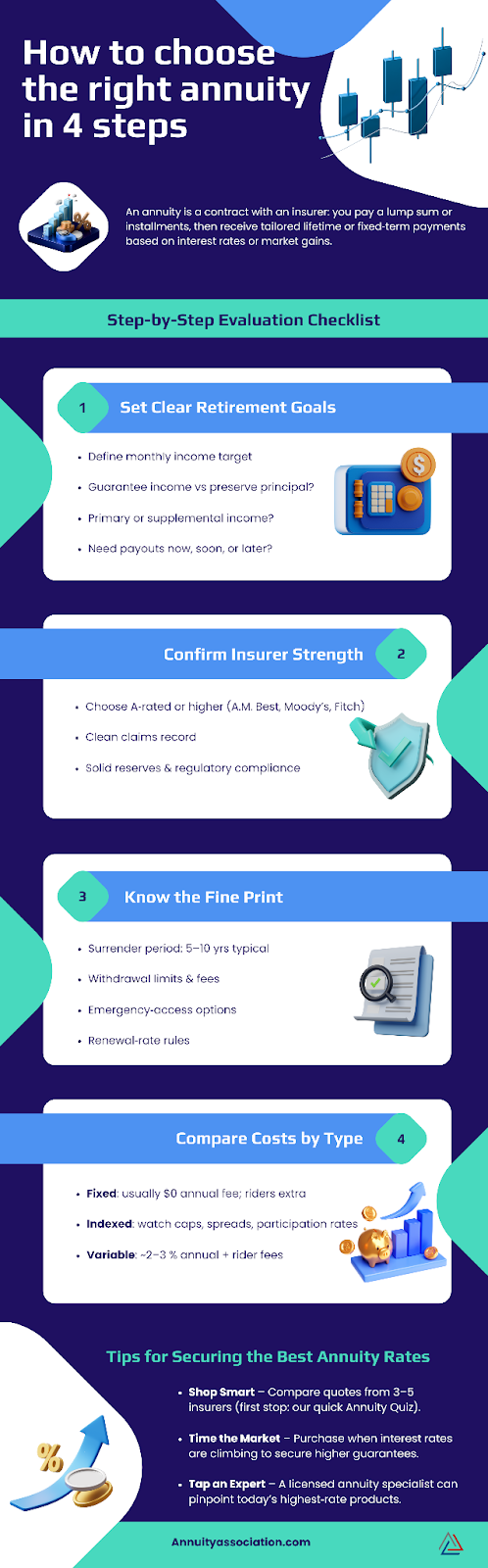
However, if something doesn’t feel right about annuities recommended to you, here’s what you can do:
- Ask for clarity. Request a clear explanation of how the annuity works, including fees, surrender charges, and how it aligns with your goals. A trustworthy advisor should be able to explain the product in plain language.
- Seek a second opinion. Consider speaking with another licensed financial professional to confirm whether the recommendation makes sense for your situation.
- Review the paperwork carefully. Before signing, go over the suitability questionnaire and disclosure documents again to make sure they accurately reflect your financial situation and goals.
- Report concerns if needed. If you believe the recommendation is unsuitable or misleading, you can contact the insurance company directly or file a complaint with your state’s department of insurance, which oversees annuity sales and consumer protections.
How Annuity Association Can Help
At Annuity Association, our professionals make annuity suitability a top priority in every client interaction.
To determine what financial products would best fit your needs, we take the time to understand your risk tolerance, liquidity needs, and retirement goals. A questionnaire and a private consultation are what we need to get to know you better.
Our approach goes beyond selling a product. We follow a thorough and transparent process designed to source annuities that align with your long-term financial objectives and may provide the peace of mind you seek for the future.
Conclusion
The annuity suitability process was introduced to protect consumers and put their interests first. Fortunately, most states have adopted the model regulation, so you should be in good hands, knowing that a broker or agent provides transparent, accurate, and relevant information.
If you want to discover what annuity products are available to you, book a consultation with our advisor at Annuity Association. We do not promote a selected few but provide unbiased guidance across a wide range of trusted providers to help you find the annuity that truly fits your needs.

Annuity Expert
Jeremiah Konger
PS - Here's 3 ways we can help you learn more about annuities.
1. Watch Videos on How to Identify The Highest Paying Protected Income & Growth Annuities.
2. Watch Videos That Reveal What to Look For When Buying A Protected Growth Annuity.
3. Click Here To Access Our Annuity Review Vault To Compare The Pro's and Con's of Dozens of Annuities.
Annuity Association is the leader in providing Independent Annuity recommendations for protected income, safe growth and other benefits in retirement.
-
Serving All 50 States
-
-
Annuity Association
759 SW Federal Hwy Ste 200H
Stuart, FL 34994


© Copyrights 2025 by Annuity Association. All Rights Reseved.